Skip to content

Arlington · Mansfield · Kennedale · Rendon · Venus · Dalworthington Gardens · Everman, TX

Benefits of Piano

A gift that shapes the whole child

Learning the piano does far more than fill a home with music. Decades of published research connect music study to real gains in the mind, the heart, and the character. Here is what the science actually shows — and why it matters for your child.

Math & spatial-temporal reasoning

The same thinking a child uses to picture how shapes fit together is the thinking that music practice exercises every day.

Some of the earliest and most cited work in this area comes from psychologist Frances Rauscher and physicist Gordon Shaw. In a 1997 study published in Neurological Research, preschool children who received piano keyboard lessons showed lasting improvement in spatial-temporal reasoning — the ability to think ahead and picture how parts fit together over time.

Later reviews have continued to explore links between sustained music instruction and mathematical thinking. The strongest, most consistent finding is qualitative and encouraging: children who study an instrument tend to strengthen exactly the kind of ordered, sequential reasoning that mathematics rewards.

Source: Rauscher, F. H. & Shaw, G. L. et al. (1997), Neurological Research.
Language, reading & verbal memory

Learning to hear music closely trains the very ear a child uses to learn to read and speak well.

Neuroscientist Nina Kraus and her Auditory Neuroscience Laboratory at Northwestern University have spent years showing that music training sharpens the brain’s processing of sound. That sharper processing supports the listening skills underneath language and literacy — how a child distinguishes speech sounds, follows a sentence, and reads.

A separate 2003 study by Ho, Cheung, and Chan in the journal Neuropsychology found that children with music training demonstrated better verbal memory than peers without it — and that the longer they trained, the stronger the effect.

Source: Kraus, N., Northwestern Auditory Neuroscience Laboratory; Ho, Cheung & Chan (2003), Neuropsychology.

Executive function, discipline & focus

Piano quietly teaches a child to plan, to stick with something hard, and to see a task through — skills that help in every subject.

Psychologist Ellen Winner (Boston College) and neurologist Gottfried Schlaug (then at Harvard Medical School) have studied how sustained instrumental training relates to children’s developing brains and behavior. Learning to read music, coordinate two hands, and prepare a piece over weeks exercises executive function — the mental skills of planning, attention, and self-control.

Related research led by Nadine Gaab and colleagues (2014, PLOS ONE) found that both children and adults with musical training showed advantages on measures of executive functioning. Practicing an instrument is, in a real sense, practicing focus itself.

Source: Winner, E. & Schlaug, G.; Zuk, Benjamin, Kenyon & Gaab (2014), PLOS ONE.

Playing with others: ensemble, duets & accompanying

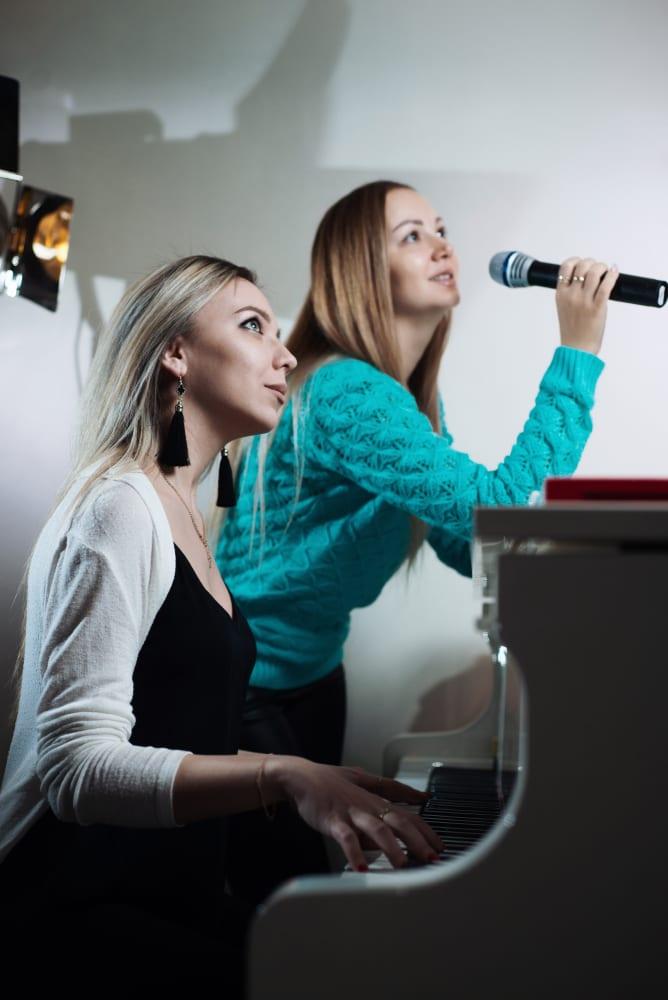
Playing with another musician — or following a singer or song leader — trains a student to listen, anticipate, and stay locked in with another person in real time.

Ask any church pianist or accompanist and they will say the same thing: playing with other people is its own skill, quite different from playing alone. Research on ensemble performance — much of it led by music scientist Peter Keller and colleagues — describes the special kind of real-time coordination it demands. A musician must listen closely, anticipate what a partner is about to do, and continually adjust their own timing to stay together. It is focus and concentration aimed squarely at another human being.

Even very young children show this. In a 2010 study by Sebastian Kirschner and Michael Tomasello, published in Evolution and Human Behavior, four-year-olds who made music together kept a shared beat and afterward behaved more cooperatively and helpfully toward one another — evidence that making music alongside others builds both rhythmic coordination and genuine attentiveness to a partner. That is exactly the skill a pianist needs to serve well: to follow the tempo a song leader sets, to move right along with a singer, or to accompany a high-school soloist in a University Interscholastic League (UIL) contest. Learning duets — with the teacher or with another student — is where that awareness is first born, and it is the foundation of good rhythm.

Source: Keller, P. E. and colleagues, research on ensemble performance and joint action; Kirschner, S. & Tomasello, M. (2010), Evolution and Human Behavior.

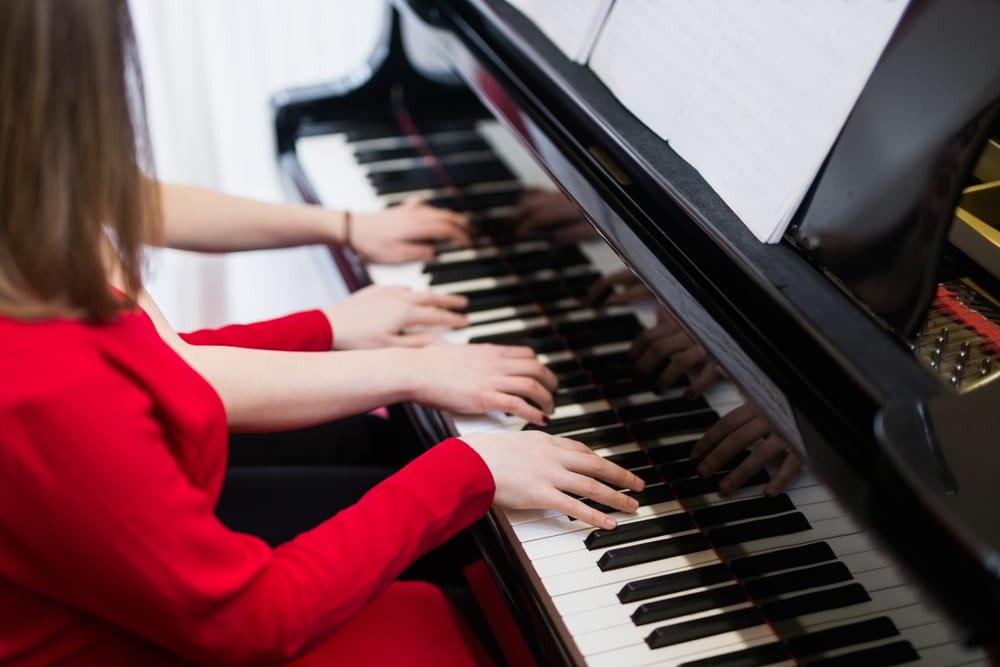
Two pianists playing a duet at the same grand piano, four hands together on the keys
A duet: four hands, one shared rhythm — learning to listen and keep time with a partner.
A pianist accompanying a singer who is holding a microphone, following her in real time
Accompanying a singer means following another person in real time — the skill a church or UIL accompanist lives on.

Poise, confidence & communication

Standing up to play — and finishing well — gives a child a kind of steadiness that shows up far beyond the piano bench.

This benefit is one every music teacher watches unfold in person. Preparing for a recital, sitting down before an audience of friends and family, and playing a piece from beginning to end teaches composure under pressure. Children learn to steady their nerves, recover gracefully from a stumble, and take quiet pride in something they worked hard for.

Playing at church adds another layer — the experience of using a skill to serve and bless others. Over two recitals a year and regular performance opportunities, that poise becomes second nature and carries straight into public speaking, classrooms, and interviews for years to come.

Source: Observed benefit of regular performance; widely reported by music educators.

Long-term cognitive benefits

A skill learned young keeps giving back — music appears to strengthen the brain in ways that last a lifetime.

Brain-imaging research led by Gottfried Schlaug and colleagues (Hyde et al., 2009, Journal of Neuroscience) found measurable structural changes in the brains of children after just over a year of instrumental training — evidence of the brain’s plasticity in response to music practice.

The benefits appear to reach into later life as well. A 2011 study by Brenda Hanna-Pladdy and Alicia MacKay in Neuropsychology found that older adults with years of musical training performed better on several cognitive tests than those without — suggesting that a skill begun in childhood can help keep the mind sharp for decades.

Source: Hyde, K. et al. (2009), Journal of Neuroscience; Hanna-Pladdy & MacKay (2011), Neuropsychology.

Piano is a lifetime skill

Unlike so many childhood activities, the piano never expires. The child who learns to play at eight can still sit down and make beautiful music at eighty. It becomes a companion for celebration and comfort, a way to serve at church, and — as the research suggests — a quiet guardian of a sharp, healthy mind for life.

Give your child this gift

A note on these findings: each benefit above summarizes real, published research from named investigators and institutions. Studies describe general trends across groups of children; individual results naturally vary. Figures are stated qualitatively rather than as precise percentages so that nothing here overstates what the research actually found.